Is Your Thyroid Stealing Your Hair? A Guide to Recovery and Regrowth
Verified By
Dr. Rahul Parashar
,
MD, DM (Endocrinology), Consultant Endocrinologist, Kailash Hospital
| Published: 11-Jun-2026
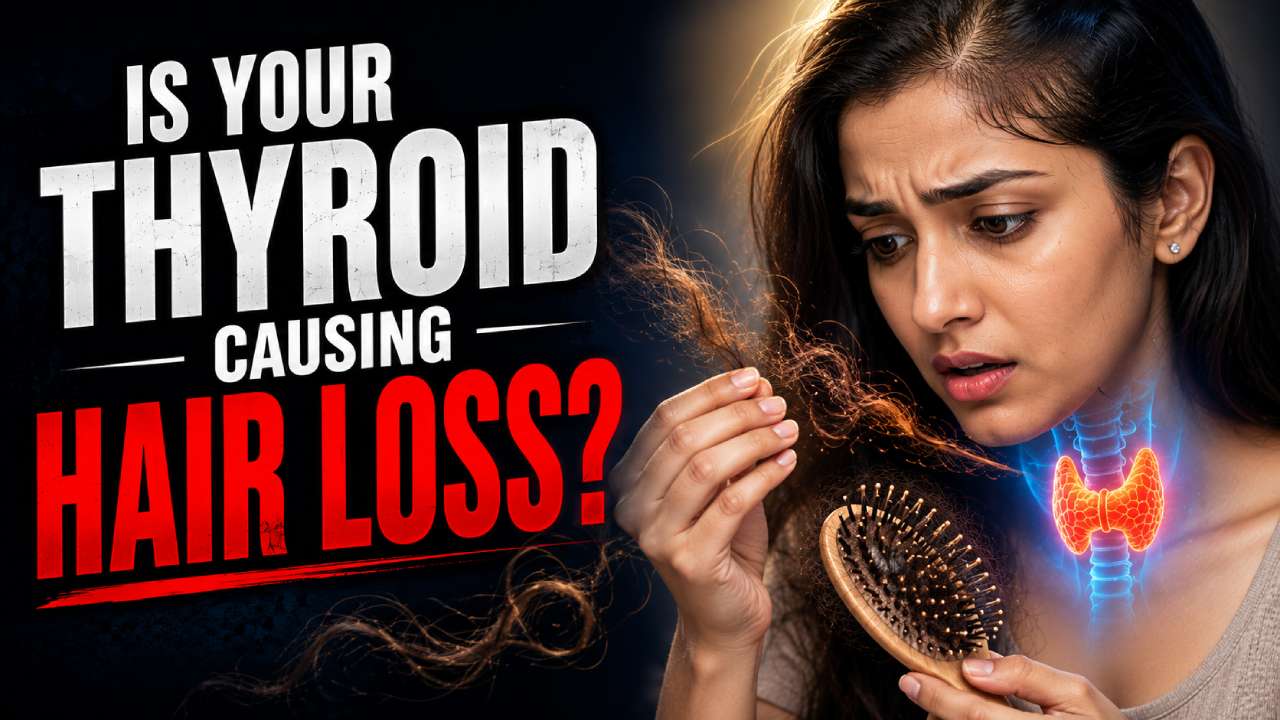
Across India, thyroid disorders affect an estimated 42 million people — and for a significant number of them, the first visible sign is not weight gain or fatigue. It is hair. A few extra strands in the comb. A widening part. A ponytail that feels thinner than it did six months ago.
Thyroid-related hair loss is one of the most distressing and most mismanaged aspects of thyroid disease. Patients spend months on serums, supplements, and cosmetic treatments without ever identifying the root cause. Understanding why this happens — and what actually drives recovery — requires looking well beyond the scalp.
Table of Content
Every hair follicle on your scalp cycles through three phases.
- The anagen phase — active growth — lasts two to seven years and accounts for roughly 85–90% of your hair at any given time.
- The catagen phase is a brief 2 to 3 weeks transition.
- The telogen phase is a resting and shedding period of approximately three months, after which the follicle resets.
Thyroid hormones T3 and T4 are direct regulators of this cycle. "Think of thyroid hormones as the director of the hair growth factory," explains Dr. Rahul Parashar, Consultant Endocrinologist. "When thyroid levels are optimal, the director ensures a smooth, continuous production line. With thyroid disease, this director is either sluggish or overactive — pushing an abnormally large number of hairs from the growing phase directly into the shedding phase. This is called telogen effluvium." (Rebora A., Clinical, Cosmetic and Investigational Dermatology, 2019)
The pattern is typically diffuse — thinning all over the scalp rather than in concentrated patches, with increased daily shedding, reduced volume, and sometimes thinning of the outer third of the eyebrows.
Also read: How Thyroid Imbalance Can Impact Fertility and Pregnancy
"One of the most common mistakes I see is that patients focus entirely on the hair loss and overlook whether their thyroid condition is actually well controlled," says Dr. Parashar. "Many assume that taking thyroid medication for a few weeks — or having a normal thyroid test once — means the thyroid is no longer contributing to their hair fall."
But there is a second, equally important mistake that Dr. Parashar flags in almost every consultation: self-adjusting supplements based on social media advice.
"Some patients begin taking high doses of biotin, iodine, or multiple hair supplements without proper evaluation. What many do not realise is that high-dose biotin supplementation can directly interfere with thyroid function test results, producing falsely abnormal TSH and thyroid hormone readings." (Piketty et al., Clinical Chemistry and Laboratory Medicine, 2017) "In some cases, this has led to incorrect dose adjustments — worsening the very condition causing the hair loss."
The third clinical oversight is one that even some doctors miss: not every hair loss in a patient with thyroid disease is caused by the thyroid. Iron deficiency, Vitamin D deficiency, PCOS, stress, nutritional gaps, and genetic hair loss frequently coexist alongside thyroid disorders. "If we focus only on the thyroid and ignore these factors," Dr. Parashar notes, "patients may continue to experience hair fall despite having well-controlled thyroid hormone levels."
The most common misconception Dr. Parashar corrects weekly is straightforward: that hair will stop falling once thyroid medication is started.
"Patients come expecting visible improvement within weeks of treatment. But hair follicles do not respond as quickly as thyroid hormone levels. Even after thyroid function normalises, the hair growth cycle takes three to six months — sometimes longer — before shedding meaningfully reduces and density begins to recover."
He recalls a woman in her early thirties who had spent nearly a year using various serums, supplements, and cosmetic treatments for progressive hair thinning, with no improvement. What stood out in consultation was that her hair loss was accompanied by persistent fatigue, weight gain, dry skin, and cold sensitivity — symptoms that had been attributed to stress. Her thyroid function had never been comprehensively assessed.
A full endocrine evaluation, including thyroid antibody testing, revealed hypothyroidism due to Hashimoto's thyroiditis. A concurrent mild iron deficiency was also identified and addressed. Appropriate thyroid hormone replacement was initiated, and critically, Dr. Parashar set clear expectations about the timeline.
"By about three to four months, her hair shedding had reduced significantly. Over the following months she noticed improved hair density, better energy, and healthier skin. More importantly, she understood that the hair loss was not a cosmetic problem — it was a manifestation of an underlying hormonal disorder that required proper diagnosis and long-term management."
Step 1 — Accurate diagnosis and medication optimisation
The foundation is correcting the underlying hormonal imbalance. A comprehensive thyroid panel — TSH, Free T3, Free T4, and thyroid antibodies — establishes the full picture. For hypothyroidism, levothyroxine is prescribed with the goal of achieving an optimal TSH, not merely a normal one.
Step 2 — Nutritional assessment
Iron is the most critical nutrient to evaluate. Ferritin — stored iron — should be above 70 ng/mL for healthy hair follicle function. Deficiency is extremely common in thyroid patients and is frequently missed. (Rushton DH, Clinical and Experimental Dermatology, 2002) Vitamin D, zinc, selenium, and protein should also be assessed and addressed through diet and targeted supplementation — not blanket hair supplement protocols.
Step 3 — Gentle hair care
Avoid tight hairstyles, heat styling, and harsh chemical treatments during the recovery period. Topical minoxidil can be a useful adjunct — it prolongs the anagen phase and increases follicle size — but it must be understood as support to medical treatment, not a replacement for it.
Step 4 — Realistic expectations
After thyroid levels are optimised: excessive daily shedding typically reduces within one to two months. Short new hairs around the hairline and parting appear between three and six months. Full recovery of density and length can take up to twelve months or more. This is not a failure of treatment — it is the biology of the hair cycle.
Also read: Beat the Heat with the Ultimate Skin Care Treat
This is where Dr. Parashar's experience diverges from standard health advice — and it is the insight that prevents the most unnecessary panic and medication adjustments.
"Hair loss is not always caused by the thyroid hormone abnormality alone — it can be triggered by the body's response to hormonal change itself," he explains. "Hair follicles are extremely sensitive to hormonal shifts. Whether thyroid function is moving from normal to abnormal, or from abnormal back to normal after treatment, the follicles can temporarily enter a resting phase — telogen effluvium — in response to the transition."
This is why some patients experience continued or even temporarily worsened hair shedding after starting thyroid treatment. The medication may be working perfectly. The thyroid levels may be normalising exactly as intended. But the hair cycle is lagging behind the hormonal correction by weeks or months.
"The key takeaway is that hair follicles are not simply responding to a thyroid lab report — they are responding to the body's overall hormonal environment and the pace at which it changes. Understanding this helps patients avoid unnecessary panic, frequent medication adjustments, and unrealistic expectations during recovery."
There is one additional warning sign Dr. Parashar watches for closely: when a thyroid patient develops patchy hair loss rather than the typical diffuse thinning. "In that scenario I become more suspicious of an associated autoimmune condition such as Alopecia Areata — particularly in patients with Hashimoto's thyroiditis, where autoimmune diseases frequently coexist." Patchy loss in a thyroid patient warrants a dermatological referral, not simply a thyroid dose adjustment.
Thyroid hair loss is reversible — but recovery requires more than a prescription. It requires an accurate and complete diagnosis, correction of every contributing factor including nutritional deficiencies, and a genuine understanding of why hair responds slowly even when treatment is working.
"Treat the thyroid appropriately, monitor thyroid function regularly, be patient with the hair growth cycle, and undergo a comprehensive evaluation for other potential causes," says Dr. Parashar. "Do not accept hair loss as an inevitable part of your thyroid disease. It is a signal that your body is calling for more precise management — and with the right approach, recovery follows."









 +91-9193939393
 international.marketing@kailashhealthcare.com