How to Control TSH Level in Female Patients: A Comprehensive Guide
Verified By
Dr. Rahul Parashar
,
MD, DM (Endocrinology), Consultant Endocrinologist, Kailash Hospital
| Published: 04-Feb-2026
Dr. Rahul Parashar, Consultant Endocrinologist at Kailash Hospital, Noida, reviews a patient's lab report with a focused expression. "A woman's TSH level is one of the most telling numbers in endocrinology. It's the pituitary gland's urgent memo to the thyroid, signalling how hard it needs to work. When I see a high TSH in a female patient, I'm not just looking at a number—I'm seeing potential symptoms of fatigue, weight struggles, hair loss, and for women of childbearing age, a direct threat to fertility and pregnancy health. Learning how to control TSH level in female patients is the cornerstone of restoring energy, metabolism, and overall well-being."
Thyroid-Stimulating Hormone (TSH) is the key indicator of thyroid function. Produced by the pituitary gland, it tells your thyroid to produce hormones (T4 and T3). A high TSH means your thyroid is underactive (hypothyroidism), while a very low TSH suggests it's overactive. For women, who are five to eight times more likely than men to develop thyroid issues, mastering TSH control is crucial. This guide, with expert insights from Dr. Rahul Parashar, provides a clear roadmap to understanding, monitoring, and effectively managing your TSH levels through medicine, lifestyle, and informed choices.
Table of Content
TSH is a sensitive feedback signal. Think of your thyroid gland as a furnace and your pituitary gland as the thermostat. TSH is the thermostat's reading.
- High TSH (e.g., >4.5 mIU/L): The "thermostat" senses it's too cold (not enough thyroid hormone), so it screams at the "furnace" to work harder. This indicates hypothyroidism.
- Optimal TSH: For most women, especially those planning pregnancy, an optimal range is tighter, often between 1.0 and 2.5 mIU/L.
- Low TSH (<0.4 mIU/L): The "thermostat" senses too much heat (excess thyroid hormone) and tells the furnace to shut off.
"The goal is not just to get TSH into the broad 'normal' lab range," explains Dr. Parashar. "It's to find your personal optimal zone where symptoms resolve, metabolism is efficient, and reproductive health is supported. This personalized target is at the heart of effective thyroid care at Kailash Hospital, Noida."
Also read: Diet for Thyroid Patients: A Complete Indian Guide to Foods to Eat and Avoid
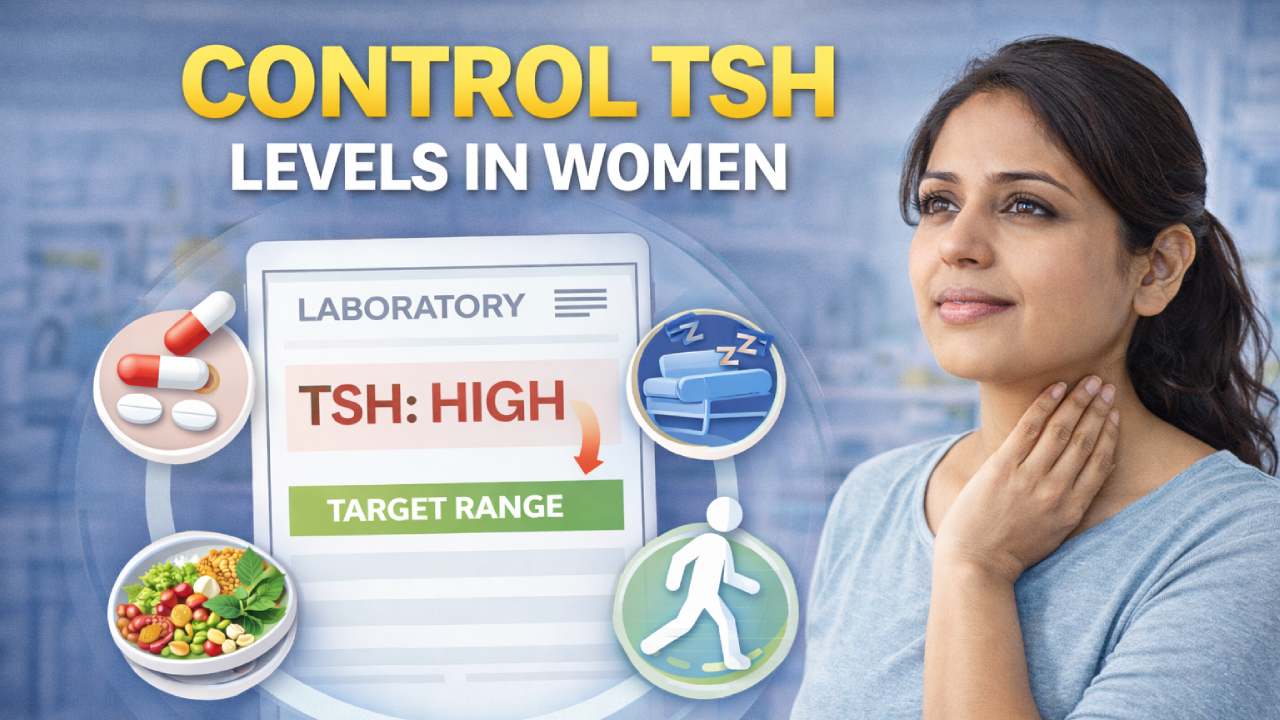
While food cannot cure hypothyroidism, strategic dietary choices can support thyroid function, improve nutrient absorption, and reduce inflammation. Think of this as how to control TSH level by food to support your medication, not replace it.
Foods and Nutrients to Emphasize:
- Iodine (The Essential Building Block):
- Role: Critical for thyroid hormone production.
- Source: Iodized salt is the primary, sufficient, and safe source for most. One teaspoon over a day meets the requirement.
- Warning: "Do not overdo seaweed, kelp supplements, or excessive iodine," cautions Parashar. "More is not better and can worsen autoimmune thyroid disease."
- Selenium (The Protector and Activator):
- Role: Vital for converting T4 to the active T3 hormone and protecting the thyroid gland from oxidative damage.
- Sources: 2-3 Brazil nuts daily provide a perfect dose. Also found in sunflower seeds, eggs, and chicken.
- Zinc (The Co-Factor):
- Role: Works with selenium in hormone conversion and supports immune function.
- Sources: Legumes (chickpeas, lentils), nuts (cashews, almonds), seeds (pumpkin, sesame), and dairy.
- Iron (The Enabler):
- Role: Necessary for thyroid peroxidase, an enzyme crucial for hormone synthesis. Iron deficiency is common in women and can worsen hypothyroid symptoms.
- Sources: Lean meat, lentils, spinach (cooked), and pumpkin seeds. Pair with Vitamin C (lemon, amla) to enhance absorption.
Foods to Consume Mindfully:
- Goitrogens (Cruciferous Vegetables): Compounds in raw broccoli, cauliflower, cabbage, and kale can interfere with iodine uptake if consumed in extremely large, raw amounts daily.
- The Solution: Cooking (steaming, boiling) deactivates over 90% of these compounds. Enjoy these nutritious vegetables cooked without fear.
- Soy: Isoflavones may interfere with hormone absorption. Consume in moderation and avoid within 3-4 hours of taking thyroid medication.
Pregnancy demands precise thyroid management. The baby relies entirely on the mother's thyroid hormones for brain development during the first trimester.
- Increased Demand: Pregnancy increases thyroid hormone demand by 20-50%. A TSH that was normal pre-pregnancy can become insufficient.
- Tighter Targets: The goal is to maintain TSH below 2.5 mIU/L (or even lower per trimester-specific guidelines) to prevent miscarriage, preterm birth, and developmental issues.
- Frequent Monitoring: TSH should be checked at pregnancy confirmation and every 4-6 weeks throughout. Medication dosage often needs an immediate 25-30% increase upon a positive pregnancy test.
"Control TSH level during pregnancy is one of the most critical interventions in prenatal care," emphasizes Dr. Parashar. "We treat it with the same urgency as managing blood pressure. At Kailash Hospital, we have protocols for rapid testing and dose adjustment to ensure both mother and baby are protected from day one."
Alongside medication and diet, these practices support overall endocrine health and can help optimize thyroid function.
- Stress Management: Chronic stress elevates cortisol, which can disrupt the HPA axis (brain-adrenal-thyroid communication) and impair T4 to T3 conversion.
- Action:Practice daily mindfulness, yoga, or deep breathing (like 4-7-8 technique).
- Prioritize Sleep: Poor sleep disrupts hormonal rhythms, including TSH secretion, which follows a circadian pattern.
- Action:Aim for 7-8 hours of quality sleep per night in a dark, cool room.
- Regular, Moderate Exercise: Intense, prolonged exercise can be a stressor, but consistent, moderate activity improves insulin sensitivity and supports metabolism.
- Action:150 minutes per week of brisk walking, cycling, or swimming.
- Limit Endocrine Disruptors: Certain chemicals in plastics (BPA), personal care products, and pesticides can interfere with thyroid receptor function.
- Action:Use glass/stainless-steel containers, choose natural cosmetics, and wash produce thoroughly.
Also read: The Hidden Danger in Your Kitchen: How Ultra-Processed Foods Are Fuelling India's Chronic Disease Epidemic
Consult a specialist if:
- Your TSH remains high or symptoms persist despite medication.
- You are planning a pregnancy or are newly pregnant.
- You have thyroid nodules or an autoimmune diagnosis (Hashimoto's, Graves').
- You need help interpreting complex thyroid panels (TSH, FT4, FT3, antibodies).
"An endocrinologist near you specializes in the delicate dance of hormones," says Dr. Rahul Parashar. "We look at the whole picture—symptoms, lab trends, lifestyle, and life stage—to fine-tune your treatment. At Kailash Hospital, Noida, we provide that precise, personalized care to not just normalize a lab value, but to restore your vitality."
Thyroid TSH high how to control is a question with a multi-faceted answer: precise medication, supportive nutrition, mindful lifestyle, and expert guidance. For women, taking command of your TSH is an act of self-care that ripples through every aspect of your health—energy, weight, mood, fertility, and longevity.
The journey to balanced TSH is a partnership between you and your healthcare team. Be an active participant: track your symptoms, take medication consistently, and communicate openly with your doctor.
If you are struggling with thyroid symptoms or the challenge of managing your TSH levels, you don't have to navigate it alone. Schedule a consultation with our endocrinology specialists at Kailash Hospital, Noida, to create a personalized plan for optimal thyroid health and well-being.









 +91-9193939393
 international.marketing@kailashhealthcare.com