How Thyroid Imbalance Can Impact Fertility and Pregnancy
Verified By
Dr. Rahul Parashar
,
MD, DM (Endocrinology), Consultant Endocrinologist, Kailash Hospital
| Published: 28-May-2026
For many couples, unexplained fertility struggles lead to months of investigations focused exclusively on reproductive organs — ovarian reserve, sperm count, uterine structure. What frequently goes unexamined is a small, butterfly-shaped gland in the neck that quietly governs the hormonal environment reproduction depends on.
The thyroid gland is one of the most common and most overlooked contributors to fertility difficulties in women of reproductive age. In my clinical practice, I routinely identify thyroid dysfunction as the underlying factor in cases that had previously been labelled unexplained — and correcting it, in many of those cases, is what finally makes conception possible.
Table of Content
Thyroid hormones — thyroxine (T4) and triiodothyronine (T3) — regulate the metabolism of every cell in the body. Their influence on the reproductive system is direct and far-reaching.
They interact with the ovaries to regulate oestrogen and progesterone production. They govern the hypothalamic-pituitary axis that controls the release of FSH and LH — the hormones that drive ovulation. They influence the thickness and receptivity of the uterine lining. And they are essential in the first trimester of pregnancy, before the fetal thyroid is functional, to support early neurological development.
When thyroid function is even subtly disrupted, the hormonal cascade required for regular ovulation, successful implantation, and a sustained pregnancy becomes unreliable.
"Think of the thyroid as the foundation of a house," I explain to patients. "If the foundation is unstable, you cannot reliably build the structures on top — regular ovulation, a receptive endometrium, a sustaining pregnancy. Reproductive medicine begins with metabolic stability, and thyroid function is central to that."
Hypothyroidism — the most common link
An underactive thyroid, particularly subclinical hypothyroidism where TSH is mildly elevated but T4 remains within range, is the most frequently missed contributor to female infertility.
The mechanisms are well established. Elevated TSH stimulates the pituitary to produce prolactin — a hormone that suppresses ovulation. Hypothyroidism also causes luteal phase defects, shortening the second half of the menstrual cycle and leaving insufficient time for the endometrium to prepare for implantation. In confirmed pregnancy, it is strongly associated with first-trimester miscarriage and impaired fetal neurodevelopment. (Alexander et al., American Thyroid Association Guidelines, Thyroid, 2017)
For women planning conception, I target a TSH below 2.5 mIU/L — a stricter threshold than the standard laboratory reference range. In my experience, women whose TSH sits between 2.5 and 4.0 — technically "normal" — can still present with an ovulatory cycles and recurrent early pregnancy loss.
Hyperthyroidism — less common, equally disruptive
An overactive thyroid is less frequently associated with infertility but carries significant risks when present. It causes irregular, infrequent periods and, in pregnancy, substantially raises the risk of preeclampsia, preterm birth, and low birth weight. Treatment before attempting conception is essential.
Autoimmune thyroid disease — the hidden layer
This is the area that, in my view, receives the least attention in fertility workups.
In Hashimoto's thyroiditis and Graves' disease, the immune system produces antibodies against thyroid tissue — most commonly thyroid peroxidase antibodies (anti-TPO). Even when TSH and T4 levels are entirely normal, the presence of these antibodies creates a systemic inflammatory environment that is hostile to embryo implantation. (Poppe et al., Clinical Endocrinology, 2007)
A landmark BMJ meta-analysis demonstrated that women with thyroid antibodies face a significantly elevated risk of miscarriage and preterm birth — independent of thyroid hormone levels themselves. (Thangaratinam et al., BMJ, 2011)
Dr. Nandita Barthwal, our consultant gynecologist, has observed this pattern repeatedly: "We now know that for some women with recurrent pregnancy loss, the problem is not the hormone level but the immune activity itself. A standard TSH test will not identify this. You need the antibody panel."
Also read: How to Control TSH Level in Female Patients: A Comprehensive Guide
I recall a 32-year-old school teacher who was referred to me after nearly three years of trying to conceive and two early miscarriages. Her previous workup had included ovarian reserve testing, pelvic ultrasound, hormonal evaluation, and her husband's semen analysis — all of which were essentially unremarkable. She had been told repeatedly that everything looked "normal," yet she continued to struggle emotionally with repeated pregnancy loss.
When I reviewed her complete thyroid panel, I found that although her T4 levels were within the standard laboratory range, her TSH was 3.8 mIU/L and her anti-TPO antibodies were strongly positive — indicating underlying autoimmune thyroid disease that had previously gone undetected. She also described symptoms she had dismissed for years: fatigue, mild weight gain, and irregular cycles.
We initiated levothyroxine therapy and monitored her thyroid levels closely, aiming for a conception-optimized TSH below 2.5 mIU/L. Within four months, her menstrual cycles became more regular, and she conceived naturally shortly thereafter. Her pregnancy was then monitored jointly by our endocrinology and gynecology teams, and she eventually delivered a healthy baby at term.
It is a case that reinforced for me that thyroid dysfunction in fertility medicine is often subtle, easily overlooked, and yet entirely capable of changing the outcome of a woman's reproductive journey when identified early and treated appropriately.
A standard TSH test alone is insufficient for women with fertility concerns. The appropriate panel includes:
- TSH — with a conception-specific target of 1.0–2.5 mIU/L
- Free T4 — to assess actual hormone availability
- Free T3 — particularly relevant in symptomatic patients with normal T4
- Thyroid Peroxidase Antibodies (anti-TPO) — to identify autoimmune disease regardless of hormone levels
I run this panel as a standard component of any unexplained fertility workup. The test is inexpensive and the information it provides can redirect an entire treatment pathway.
For hypothyroidism, levothyroxine therapy is the cornerstone. Dosage requires careful titration — the target is not simply within range, but optimized for conception. Importantly, once pregnancy is confirmed, levothyroxine requirements typically increase by 25–30% from the first weeks. Women on this medication need to know this before they conceive, not after.
For women with positive thyroid antibodies and a history of recurrent loss, management is more nuanced. Evidence supports consideration of low-dose aspirin and, in some cases, immune-modulating protocols — though these decisions require specialist oversight and must be individualized. (Negro et al., Journal of Clinical Endocrinology and Metabolism, 2006)
Dr. Barthwal emphasizes the collaborative dimension of this care: "Thyroid optimization and gynecological management cannot run in parallel without communication. We review these patients together, because the decisions in one specialty directly affect outcomes in the other."
Also read: Top 5 Early Signs of Endometriosis Every Woman Shouldn’t Ignore
For couples proceeding to assisted reproduction, thyroid optimization is non-negotiable before any cycle begins.
Dr. Monika Gupta, who leads our Kailash IVF centre, is unequivocal on this: "No embryo transfer proceeds at our centre until thyroid levels are confirmed optimal. The uterine environment has to be right before advanced technology can do its work."
In IVF patients with autoimmune thyroid disease and prior implantation failure, the management layer extends further — intralipid therapy and anticoagulation protocols are considered alongside thyroid management to reduce the immunological barrier to implantation. Thyroid function is then monitored weekly in early pregnancy, reflecting the elevated risk profile of this patient group.
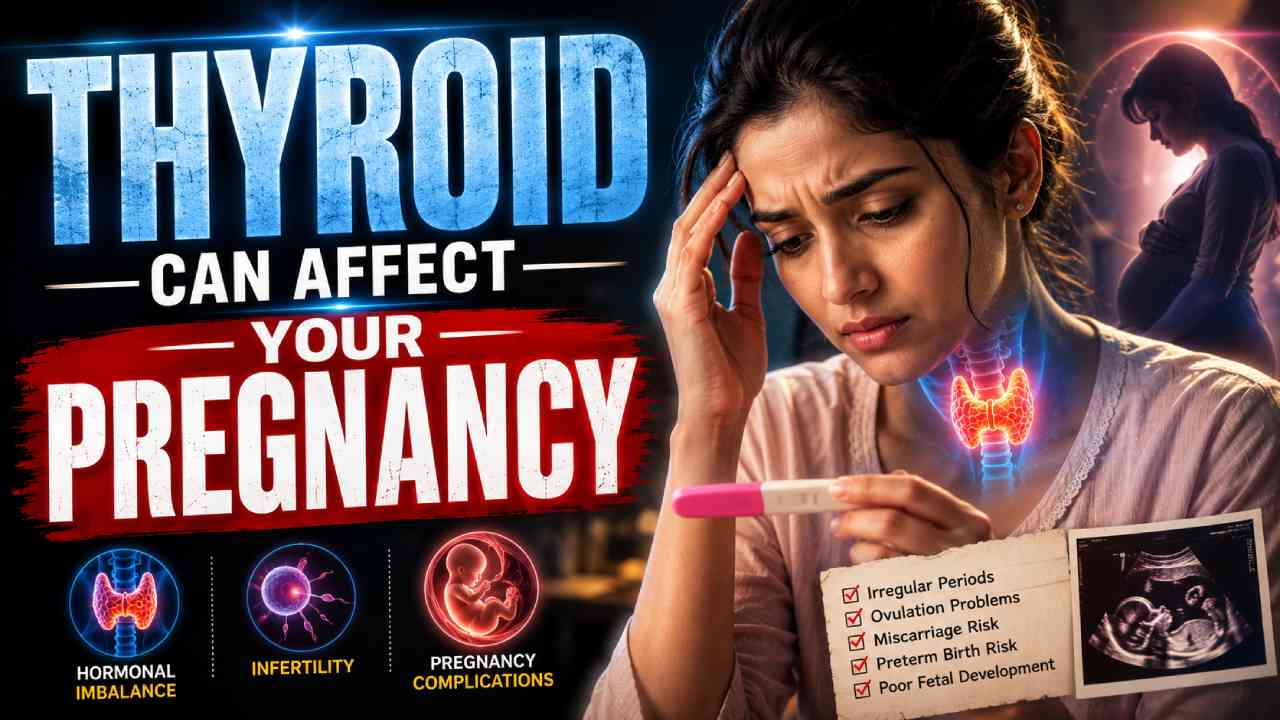
Many women with thyroid dysfunction have no obvious symptoms — which is precisely why screening matters. However, the following should prompt a full thyroid panel in any woman planning pregnancy or experiencing fertility difficulty:
- Irregular, heavy, or absent menstrual cycles
- Unexplained fatigue disproportionate to activity levels
- Unexplained weight gains or difficulty losing weight
- Recurrent first-trimester miscarriage
- Prior IVF failure without clear cause
- Family history of autoimmune conditions
Thyroid dysfunction is one of the most common, most treatable, and most overlooked causes of female infertility and pregnancy loss. It does not always produce obvious symptoms. It does not show up on ovarian or uterine imaging. And a standard TSH within the laboratory reference range does not rule it out in the fertility context.
A complete thyroid panel — including antibodies — before attempting conception is one of the most valuable and least invasive investigations a woman can have.
"My message to every woman planning a pregnancy is straightforward," I tell my patients. "Get your thyroid checked first. Don't wait for something to go wrong. A blood test taken before you start trying can prevent months of uncertainty later."
If you have irregular cycles, a history of miscarriage, or have been trying to conceive without success for more than six months, ask your doctor for a full thyroid panel. It may be the investigation that changes everything.









 +91-9193939393
 international.marketing@kailashhealthcare.com