8 Early Signs That May Point to Parkinson's Disease
Verified By
Dr. Shrikant Sharma
,
MS, MCh (Neurosurgery), Director Neurosciences, Kailash Hospital
| Published: 14-Feb-2026
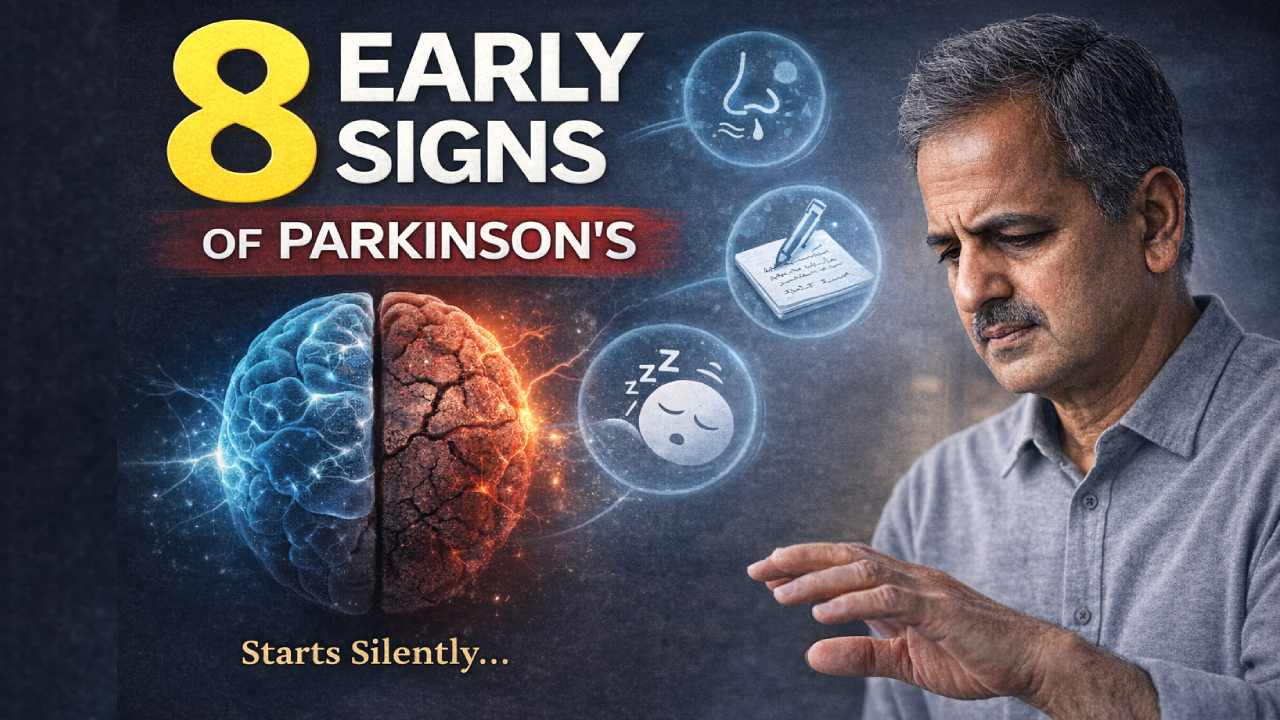
Dr. Shrikant Sharma, Director Neurosciences at Kailash Hospital & Neuro Institute, observes a patient's handwriting with a thoughtful expression. "The earliest signals of Parkinson's don't always begin with a noticeable tremor. Often, they manifest in subtle, almost hidden ways—a slight change in handwriting, a loss of smell, or disturbed sleep. Recognizing these early Parkinson's disease signs is crucial because while we cannot yet prevent the disease, early intervention can dramatically slow its progression and preserve quality of life for years."
Parkinson's disease is a progressive neurological condition that impacts how a person moves. It develops gradually, often starting with minor symptoms that are easy to dismiss. Getting a grasp on these early warning signs is crucial for seeking prompt evaluation from a top neurologist in Noida. This listicle explores the key, and sometimes surprising, early indicators of Parkinson's.
Table of Content
Parkinson’s disease is a chronic neurological condition caused by the gradual loss of dopamine-producing neurons in the brain. Dopamine plays a crucial role in ensuring our muscle movements are smooth and well-coordinated. When dopamine levels start to drop, you might notice that movements become slower, stiffer, and less steady.
Parkinson’s disease causes include:
- Degeneration of nerve cells in the brain
- Genetic predisposition
- Environmental factors
- Aging-related neurological changes
Dr. Sharma explains: “Parkinson’s disease is not a single-symptom disorder. It affects motor and non-motor functions, which is why early signs are often overlooked.”
Also read: Recognizing the Early Signs of Alzheimer's in Your 50s Before It's Too Late
1. The Disappearing Smell (Loss of Smell - Hyposmia)
One of the most common yet least recognized early Parkinson's disease symptoms is a diminished sense of smell (hyposmia) or a complete loss (anosmia). This can occur years before motor symptoms appear.
- What it feels like: You might struggle to smell spices, notice that food tastes bland, or fail to detect strong odors like petrol or perfume. It's often noticed by a partner or family member first.
- The Science: Parkinson's is believed to affect the olfactory bulb—the part of the brain responsible for processing smells—very early in the disease process.
- Dr. Sharma's Insight: "When a patient in their 50s or 60s mentions a gradual loss of smell without a history of sinus issues, it raises an important flag for us. It's a non-motor symptom that can precede the classic tremor by a decade or more."
2. The Shrinking Script (Micrographia)
A sudden, persistent change in handwriting is a classic and specific early sign. This is known as micrographia.
- What it looks like: Your handwriting becomes noticeably smaller, more cramped, and more crowded than before. The letters may also appear to trail off at the end of a word or sentence.
- The Science: This results from the brain's increasing difficulty in coordinating and automating fine motor movements, a core challenge in Parkinson's.
- Dr. Sharma's Insight: "Compare a cheque signature from five years ago to one today. If the recent one is consistently tiny and squeezed, it's not just 'getting older'—it's a potential neurological sign worth discussing with a specialist."
3. The Restless Nights (REM Sleep Behavior Disorder)
Vivid, violent dreams where you physically act out—shouting, punching, or kicking—can be more than just bad dreams. This is a specific sleep disorder called REM Sleep Behavior Disorder (RBD).
- What it feels like: Your body fails to enact the normal paralysis that occurs during REM sleep (the dream stage). You may yell, flail, or even fall out of bed, often remembering intense, action-filled dreams.
- The Science: RBD is strongly linked to synucleinopathies, the category of brain diseases that includes Parkinson's. It's considered one of the strongest predictive Parkinson's disease signs.
- Dr. Sharma's Insight: "This is often reported by a spouse. If someone is physically acting out dreams, it's a significant red flag that warrants a sleep study and neurological evaluation at a center like Kailash Hospital & Neuro Institute."
4. The Stiff Shoulder or Aching Limb
Before a tremor appears, many people experience stiffness, pain, or a reduced swing in one arm. This is often misdiagnosed as a rotator cuff injury, arthritis, or a simple strain.
- What it feels like: A persistent ache in the shoulder, elbow, or hip on one side of the body. The arm may not swing naturally when walking. The stiffness doesn't improve with typical physiotherapy for a joint issue.
- The Science: This is due to increasing rigidity and bradykinesia (slowness of movement), key motor features of Parkinson's, beginning asymmetrically.
- Dr. Sharma's Insight: "We see many patients who have been treated for a frozen shoulder for months without improvement. When the stiffness is accompanied by subtle slowness, it's time to look at a neurological Parkinson's disease cause."
5. Soft or Low Voice (Hypophonia)
Your voice may become softer, hoarse, or more monotone. You might feel you have to strain to be heard, or others are constantly asking you to repeat yourself.
- What it feels like: A loss of vocal power and inflection. Your speech may become a flat mumble.
- The Science: Parkinson's affects the automatic control of the muscles in the larynx (voice box) and diaphragm, robbing speech of its volume and prosody.
- Dr. Sharma's Insight: "This change is so gradual that the individual often doesn't notice it. Family members are key here. If they say, 'You're not speaking clearly anymore,' it should be taken seriously."
6. Reduced Facial Expressions (Hypomimia)
This involves a reduction in automatic facial expressions, making a person appear serious, blank, or unhappy even when they are not—a "masked face."
- What it looks like: Less frequent blinking, a lack of smile in response to a joke, or a general decrease in animated facial movements.
- The Science: The same automatic motor control deficit affects the myriad tiny muscles of the face.
- Dr. Sharma's Insight: "It's often mistaken for depression or disinterest. But in the context of other signs, it's part of the motor circuitry slowing down. The emotion is there; its physical expression is dampened."
7. The Internal Tremor (and Later, the Visible One)
While not always the first sign, a slight tremor in a finger, thumb, hand, or chin while the limb is at rest is the most iconic symptom.
- What it feels like: A rhythmic shaking, often described as "pill rolling" between the thumb and forefinger. It disappears or lessens with voluntary movement and returns at rest. Crucially, many report a sensation of internal trembling or vibration before it becomes visible.
- The Science: This results from disordered signaling in the brain regions that control movement.
- Dr. Sharma's Insight: "A rest tremor is a cardinal sign. But don't wait for it. The non-motor symptoms—loss of smell, sleep disorders, micrographia—are the true early sentinels. Heeding them allows for the earliest possible intervention."
8. Stooped Posture and Postural Instability
A gradual change in posture, leading to a stooped, hunched, or leaning forward stance, is a hallmark motor sign of Parkinson's.
- What it looks and feels like: The head and shoulders begin to droop forward. The back becomes rounded, and the knees may be slightly bent. This is often accompanied by a feeling of being off-balance or a tendency to take quick, shuffling steps (festination) to prevent falling forward. A simple "pull test" performed by a neurologist—a gentle tug backward on the shoulders—may reveal an impaired ability to recover balance.
- The Science: This results from the combination of rigidity in the trunk muscles and a loss of the automatic, postural righting reflexes that keep us upright against gravity. It is directly related to the neurodegeneration in the brain's movement control centers.
- Dr. Sharma's Insight: "We often see patients whose family says, 'Stand up straight!' but they physically can't. This stooped posture isn't poor habit; it's a neurological symptom. When combined with a shuffling gait and reduced arm swing, it paints a clear clinical picture of advancing Parkinson's. Addressing this early with targeted physiotherapy is vital to prevent falls and maintain mobility."
Neurologists use the Hoehn and Yahr scale to track the progression of the condition. Understanding the parkinson's disease stages helps doctors tailor the treatment plan:
- Stage 1: Symptoms are usually mild and tend to affect just one side of the body. They usually do not interfere with daily activities.
- Stage 2: Symptoms affect both sides of the body. Walking and posture may be affected, but the patient is still independent.
- Stage 3: This is the mid-stage. Loss of balance and slowness of movement are hallmarks. Falls become common, and daily tasks are significantly impaired.
- Stage 4: Symptoms are severe and limiting. Patients may be able to stand without help but require a walker for mobility. They can no longer live alone.
- Stage 5: This is the most advanced stage. Stiffness in the legs may make it impossible to stand or walk. The patient is usually wheelchair-bound or bedridden and requires around-the-clock nursing care.
Also read: Decoding AVM, Brain Aneurysm and Trigeminal Neuralgia – A Neurosurgeon’s Lifesaving Guide
While there is no cure, modern Parkinson's disease treatment is highly effective at managing symptoms. Dr. Shrikant Sharma and his team at the best neuro hospital in Noida offer a comprehensive, multidisciplinary approach:
- Personalized Medication Management: The cornerstone of treatment, using levodopa and other drugs to manage symptoms.
- Advanced Surgical Options: For eligible patients, Deep Brain Stimulation (DBS) surgery can be transformative, significantly reducing tremor, stiffness, and slowness.
- Specialized Rehabilitation: A dedicated team of physiotherapists, occupational therapists, and speech-language pathologists works to maintain mobility, balance, and communication.
- Neuroscience Expertise: As the Director Neurosciences, Dr. Sharma leads a team that manages the full complexity of the disease, from diagnosis through advanced care.
"The goal at Kailash Hospital & Neuro Institute is not just to treat a disease, but to empower a person," says Dr. Sharma. "Early diagnosis allows us to build a long-term management plan that keeps patients active, independent, and engaged with life for as long as possible. If you notice these subtle signs in yourself or a loved one, do not dismiss them. A consultation with a neurologist is the most proactive step you can take."
Parkinson’s disease rarely begins suddenly. It develops through subtle changes in movement, posture, mood, and coordination. Recognizing these Parkinson’s disease signs early allows for timely treatment, better symptom management, and improved quality of life.
With expert neurological care from Dr. Shrikant Sharma, Director Neurosciences at Kailash Hospital & Neuro Institute, patients have access to advanced diagnosis and compassionate, long-term care at one of the best neuro hospitals in Noida.









 +91-9193939393
 international.marketing@kailashhealthcare.com