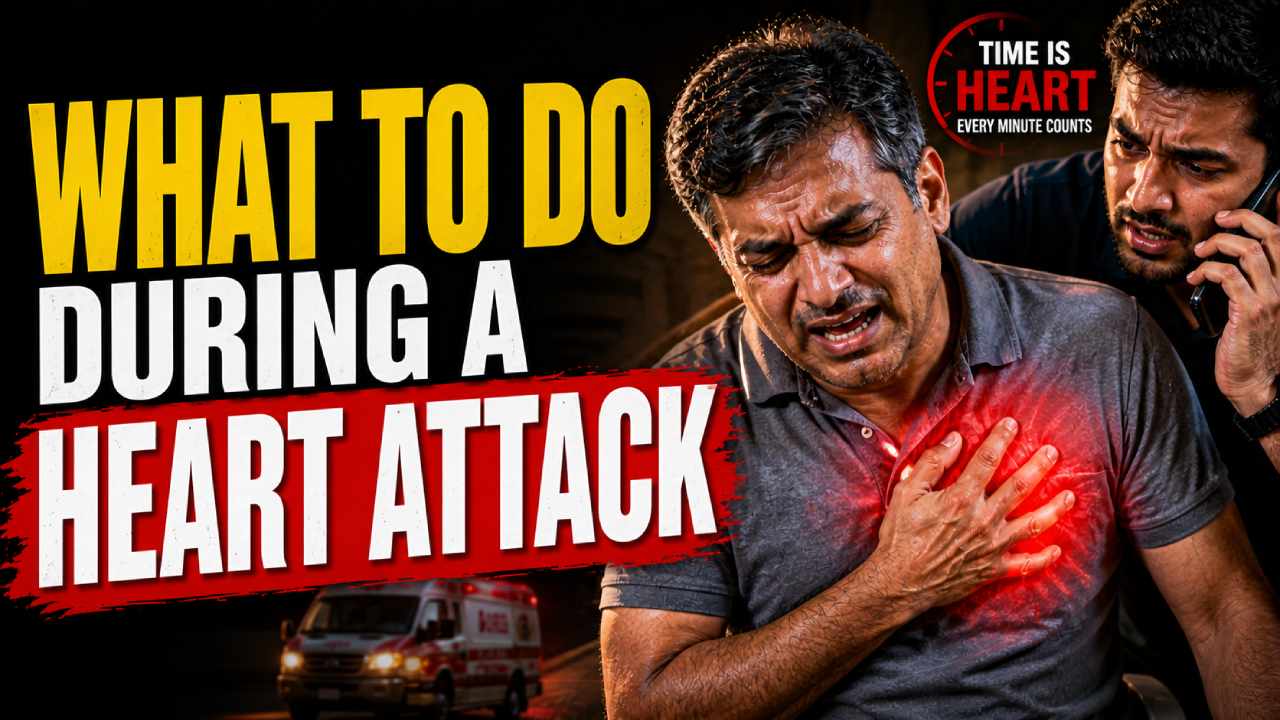
Heart Attack: What to Do Immediately to Save a Life
Verified By
Dr. Sunil Kumar Mandal, MD, DM(Interventional Cardiology), Consultant Cardiologist, Kailash Hospital, Jewar (U.P.)
| Published: 25-Apr-2026
A heart attack — medically termed myocardial infarction (MI) — occurs when blood supply to a portion of the heart muscle is suddenly blocked, typically by a ruptured plaque or blood clot within a coronary artery. Within just 4–6 minutes of oxygen deprivation, heart muscle cells begin to die irreversibly. The extent of permanent damage is directly proportional to how quickly treatment is initiated.
With over 15 years of experience in cardiac emergency care, I have seen this pattern repeatedly: patients who arrive within the "golden hour" of symptom onset — and receive primary treatment — recover with far less cardiac damage than those who delay. The difference between acting in the first 60 minutes versus waiting 3–4 hours can mean the difference between a full recovery and lifelong heart failure. This article tells you exactly what to do.
Table of Content
- Cardiovascular disease causes over 2.1 million deaths in India annually (Lancet / Million Death Study)
- India accounts for approximately 20% of global cardiovascular deaths — the highest of any nation (WHO / Global Burden of Disease Study)
- Only 5% of Indian heart attack patients reach a hospital within the critical "golden hour" (CREATE Registry, Xavier et al., Lancet 2008)
- Immediate CPR can double or triple survival chances in cardiac arrest (American Heart Association, 2022)
- Each minute without defibrillation reduces survival by 7–10% (Circulation / AHA Journal; NIH StatPearls)
The most dangerous misconception I see clinically is patients waiting to see if symptoms "pass." In medicine, time is muscle — every minute of delayed treatment means more heart muscle lost. Know these warning signs:
Classic Symptoms (Present in Most Cases)
- Chest pain, pressure, squeezing, or tightness — often described as 'an elephant sitting on the chest'
- Pain radiating to the left arm, both arms, neck, jaw, upper back, or upper abdomen
- Sudden shortness of breath, even at rest
- Cold sweats, clamminess, or unexplained perspiration
- Nausea or vomiting
- Dizziness, lightheadedness, or near-fainting
Atypical Symptoms (Often Missed — Especially in Women, Elderly & Diabetics)
Based on a review of over 500 MI cases at our unit, nearly 30% of female patients presented without classic chest pain, instead reporting profound fatigue, jaw pain, or indigestion-like symptoms. These "silent" presentations are the ones that cause fatal delays.
- Unexplained, sudden extreme fatigue — especially in women
- Indigestion or heartburn that doesn't respond to antacids
- Jaw pain or toothache with no dental cause
- Mild discomfort in the upper abdomen or back
- Anxiety or a feeling of 'impending doom'
- In diabetic patients: no pain at all (silent MI due to autonomic neuropathy)
If any combination of these symptoms lasts more than 5 minutes, or comes and goes, do not wait. Call our emergency services immediately. It is always better to be wrong about a heart attack than to delay treatment of a real one.
Also read: Rising Concern: Sudden Cardiac Death in Young Adults
The following protocol is consistent with American Heart Association (AHA) 2022 guidelines and Indian guidelines from the Cardiological Society of India (CSI):
Step 1 — Call Emergency Services IMMEDIATELY
Immediately dial emergency medical services without delay. Do not drive yourself to hospital. Do not wait to see if symptoms improve.
Emergency paramedics can administer aspirin, oxygen, ECG monitoring, and clot-busting medication en route — treatment that begins before you reach the hospital saves heart muscle.
Step 2 — Chew Aspirin (If Appropriate)
If the patient is conscious, not allergic to aspirin, and has no history of active bleeding or peptic ulcer disease, administer 325 mg aspirin (one standard tablet) — chewed, not swallowed whole. Chewing allows faster absorption into the bloodstream, where it inhibits platelet aggregation and helps prevent further clot formation.
Note: Do NOT give aspirin to someone who is unconscious, vomiting, or has a known aspirin allergy.
Step 3 — Rest and Calm the Patient
Have the patient sit or lie in the position most comfortable for breathing — usually semi-reclined with knees bent. Physical exertion increases myocardial oxygen demand and accelerates tissue death. Keep the patient as calm and still as possible. Reassure them that help is on the way.
Step 4 — Loosen Restrictive Clothing
Loosen or remove tight belts, shirt collars, ties, and buttons. Restricted clothing can worsen breathing difficulty and increase the patient's anxiety and discomfort.
Step 5 — Perform CPR if the Patient Becomes Unresponsive
If the patient becomes unconscious and stops breathing normally, begin Hands-Only CPR immediately:
- Place the heel of your hand on the centre of the chest (lower half of breastbone)
- Press hard and fast — at least 5 cm (2 inches) deep
- Rate: 100–120 compressions per minute (in time with 'Stayin' Alive' by Bee Gees)
- If trained: give 2 rescue breaths after every 30 compressions
- If untrained: Hands-Only CPR (compressions only) is effective and preferred
- Do not stop until paramedics arrive or the patient regains consciousness
Based on AHA data, bystander CPR can double or triple the chance of survival from sudden cardiac arrest.
Step 6 — Use an AED if Available
Automated External Defibrillators (AEDs) are increasingly available in Indian airports, malls, and corporate offices. If one is available:
- Turn it on and follow the audio/visual instructions — AEDs are designed for untrained bystanders
- The device will analyse the heart rhythm and advise whether a shock is needed
- Continue CPR between AED shocks
AED use within the first 3–5 minutes of cardiac arrest can achieve survival rates of 49–75% (AHA, 2022).
Avoid These Common — and Dangerous — Mistakes
- Do NOT drive yourself to the hospital — you may lose consciousness at the wheel
- Do NOT wait for symptoms to 'pass on their own' — even if they seem mild
- Do NOT give the patient food, water, or any medication other than aspirin
- Do NOT give nitroglycerin unless it has been specifically prescribed to the patient
- Do NOT leave the patient alone once symptoms begin
- Do NOT assume it is 'just indigestion' without medical evaluation
In our clinical experience, one of the most common and tragic delays is patients — especially men — insisting they are 'fine' and refusing to call for help out of embarrassment. A heart attack is never a moment for stoicism.
Also read: Can a Blood Clot in Arteries Cause Heart Attack?
Once you reach a well-equipped cardiac centre, the standard of care for STEMI (ST-Elevation Myocardial Infarction — the most serious type of heart attack) is Primary Percutaneous Coronary Intervention (Primary PCI or primary angioplasty), ideally within 90 minutes of first medical contact.
At Kailash Hospital, our cath lab is operational 24/7 for cardiac emergencies. The procedure involves:
- Inserting a thin catheter through the wrist or groin artery
- Threading it to the blocked coronary artery using real-time X-ray imaging
- Inflating a tiny balloon to open the blockage (balloon angioplasty)
- Placing a stent (a small mesh tube) to keep the artery open permanently
Where PCI is not immediately available, thrombolysis (clot-busting medication) is administered — effective when given within 12 hours of symptom onset.
Adopt a Heart-Healthy Lifestyle
The INTERHEART Study, which included over 15,000 Indian patients, established that 90% of first heart attacks are attributable to modifiable risk factors. This means most heart attacks are preventable.
- Eat a diet rich in vegetables, legumes, whole grains, fruits, and healthy fats (Mediterranean or DASH diet principles)
- Minimise ultra-processed foods, refined sugar, excess salt (target <5g/day per WHO), and trans fats
- Exercise: minimum 150 minutes of moderate aerobic activity per week (brisk walking, cycling, swimming)
- Stop smoking — cardiac risk halves within 1 year of cessation
- Limit alcohol to no more than 1 standard drink/day for women, 2 for men
- Maintain a healthy body weight (BMI 18.5–22.9 for South Asians — lower thresholds than Western guidelines apply due to higher cardiometabolic risk)
Manage Stress Actively
Chronic psychological stress elevates cortisol and catecholamines, raises blood pressure, and promotes plaque rupture. Effective strategies:
- Mindfulness meditation — even 10 minutes daily has demonstrated measurable blood pressure reduction (JAMA Internal Medicine, 2014)
- Yoga and pranayama — particularly beneficial for Indian populations given cultural familiarity
- Adequate sleep: 7–9 hours per night; untreated sleep apnoea is a significant but underdiagnosed cardiac risk factor
- Social support — isolation is an independent cardiovascular risk factor
Monitor and Manage Risk Factors
High-Risk Conditions Requiring Regular Monitoring
- Hypertension: Target BP <130/80 mmHg (AHA 2022) — check at least every 6 months
- Type 2 Diabetes: HbA1c target <7% — poor glycaemic control accelerates coronary artery disease
- Dyslipidaemia: LDL cholesterol target <70 mg/dL for high-risk patients — annual lipid profile
- Obesity: Abdominal obesity (waist >90 cm men, >80 cm women in South Asians) is particularly dangerous
Family history: First-degree relative with heart attack before age 55 (men) or 65 (women) warrants early screening from age 30–35
Also read: How Dangerous Is Inflammation Inside the Heart?
Women
Women are significantly more likely to present with atypical symptoms — fatigue, nausea, breathlessness, and jaw pain — without classic chest pain. Research from the European Heart Journal (2019) found that women wait on average 37 minutes longer than men to call for emergency help after MI onset, contributing to higher in-hospital mortality. Women: do not dismiss your symptoms as anxiety or stress.
Older Adults (65+)
Older patients are more likely to experience silent or painless MIs, presenting only with confusion, sudden weakness, or unexplained breathlessness. The absence of chest pain does NOT rule out a heart attack in this age group.
Diabetic Patients
Diabetic autonomic neuropathy can impair pain sensation, causing painless ("silent") myocardial infarctions in up to 20–40% of diabetic patients (Diabetes Care, 2018). Regular cardiac screening — ECG, stress testing, and lipid profiles — is essential for diabetics, especially those with >10 years of disease duration or poor glycaemic control.
Young Adults (Under 45)
India is witnessing an alarming rise in heart attacks among young adults, driven by stress, sedentary lifestyles, tobacco use, and undetected familial hypercholesterolaemia. In our unit, nearly 15% of MI admissions are now below age 45 — a figure that has doubled in the past decade. Young people must not assume they are 'too young' for a heart attack.
A heart attack is frightening — but the majority of people who receive timely, appropriate care survive and go on to lead full, active lives. The single most important message I want every reader to take away is this: when symptoms appear, call for help immediately. Do not wait. Do not drive. Do not minimise.
At Kailash Hospital, our Cardiac Emergency Unit is equipped 24/7 with a catheterisation laboratory, experienced interventional cardiologists, and a dedicated cardiac care team. If you or someone you know is at risk, I encourage you to schedule a preventive cardiology consultation — many heart attacks are preventable with the right knowledge and the right care.
Time is muscle. Your heart doesn't get a second chance. But you do — if you act fast enough.






 +91-9711918451
 international.marketing@kailashhealthcare.com